

You can write great pages and still sit on page three of Google. Often the reason is what happens outside your website: who links to you, what people say about you, and whether anyone knows your name. This Off Page SEO checklist walks you through those outside activities one step at a time. At RK Info Tech we use the same Off Page SEO checklist with our own clients, and it suits a small shop, an online store, or a service company equally well.
What Is Off-Page SEO?
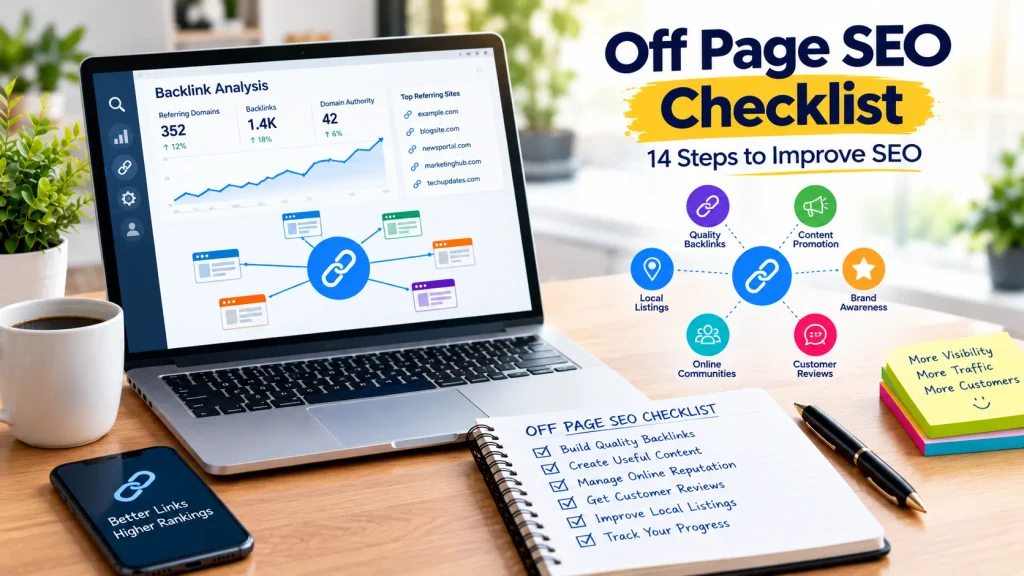
Off-page SEO is everything you do away from your own site to build trust. That means backlinks, brand mentions, reviews, and a presence in industry communities. It sits beside on-page SEO (your content) and technical SEO (your site’s health). You need all three, and an Off Page SEO checklist keeps the outside part from being forgotten.
1. Look at Your Backlink Profile First
Backlinks are links from other sites to yours. Google treats them as one signal of relevance and reputation, but quality counts far more than quantity. A link from a respected site in your field beats ten from random pages.
Start your Off Page SEO checklist by asking a few questions:
- Who links to us?
- Are those sites related to our industry?
- Which of our pages get the most links?
- Do any links come from suspicious sites?
- Who mentions our brand without linking to us?
Google Search Console and other backlink tools can answer most of this. Don’t buy links in bulk or join link schemes. It’s the fastest way to get into trouble.
2. Earn Quality Backlinks
The best links come because someone found your page worth referencing. Publish guides and original research, build resources your industry actually uses, team up with related businesses, and offer expert comments to publications. For instance, RK Info Tech could write a thorough SEO guide that other business sites want to cite. Earning links is the heart of any Off Page SEO checklist, but it’s also the slowest part, so keep quality ahead of numbers.
3. Fix Broken Backlinks
Sometimes another site links to a page you deleted or moved. That visitor lands on an error and leaves. Check your backlink report for links pointing to missing pages. If the page moved, redirect the old URL to a relevant new one. If the link itself is wrong, email the site owner and ask for a correction. Don’t send everything to your homepage, because the destination should match what the link promised. This small job belongs on every Off Page SEO checklist because it recovers value you’ve already earned.
4. Create Content Worth Sharing
People link to things that help them. Answer common questions and solve real problems. Step-by-step guides, industry checklists, original research, case studies with real results, and practical tutorials all work well. An article on common SEO mistakes, for example, helps small business owners spot problems on their own sites. Don’t write thin articles just to chase links. Write for the reader and the links tend to follow. Good content feeds every other item on your Off Page SEO checklist.
5. Use Guest Posting Carefully
Guest posting means writing an article for another website. Done well, it puts your expertise in front of a new audience and builds industry relationships.
Before you pitch, ask yourself:
- Is the site related to my industry?
- Does it publish original, useful articles?
- Is its audience relevant to my business?
- Will my piece give readers real value?
Stay away from sites that publish anything and everything, or sell links to manipulate rankings. On an Off Page SEO checklist, guest posting should be about reaching the right readers, not collecting links at any cost.
6. Keep Business Listings Accurate
Check your name, address, phone number, website, and opening hours wherever your business is listed, starting with your Google Business Profile. Make sure the website link works, the phone number is current, the category fits, and duplicates are dealt with. Pick reputable, relevant directories instead of submitting to every one you find. Accurate listings are a quiet but dependable part of any Off Page SEO checklist.
7. Look After Your Online Reputation
Before calling you, people often read your reviews, glance at your social pages, or search for your business name. Ask customers for honest feedback, respond politely, handle complaints professionally, and share customer stories only with permission. Never use fake reviews or misleading claims. You can’t control every review, but you can control how you reply. That’s why reputation work earns a place on your Off Page SEO checklist.
8. Encourage Genuine Reviews
Reviews matter most for local businesses because they show what other customers experienced. Ask for feedback once a job or sale is complete, and share a direct review link to make it easy. Thank people, and if someone raises a problem, reply calmly and offer a way to fix it. Never buy reviews or give rewards for positive ones. Reviews won’t replace a full SEO strategy, but honest ones build trust and support your local presence. Treat them as a fixed line on your Off Page SEO checklist.
9. Promote Your Content on Social Media
Social platforms help your content reach people who might care about it. Share blog posts, short videos, guides, and case studies where your audience spends time. RK Info Tech, for example, shares SEO tips and website advice on its own accounts. Answer questions, join relevant conversations, and invite people to visit useful pages. Social links don’t work like editorial backlinks, but they spread awareness, and awareness often leads to natural links.
10. Build Relationships With Relevant Websites
Off-page SEO isn’t only about links. Connect with website owners, publishers, and local businesses. Collaborate on resources, give expert comments, and attend industry events. A digital marketing company might team up with a web development firm on a guide to SEO-friendly websites. Strong relationships bring referrals and natural mentions. Skip the generic mass email to hundreds of sites, because people can tell. Relationship building is the human side of an Off Page SEO checklist.
11. Monitor Your Brand Mentions
Sometimes a site mentions your business without linking to it. Track your business name and key brand terms to spot these. If the mention is relevant, politely ask whether a link would help their readers find more information. Not every mention deserves a link request. Mentions also show how people talk about you online. Add mention tracking to your Off Page SEO checklist and review it every month.
12. Join Online Communities
Forums, professional groups, and question-and-answer sites let you meet people with questions in your field. Answer accurately, share useful advice, follow the community rules, and avoid repeating promotional posts. Recommend your site only when it truly helps. If someone asks about website speed, you could explain the fix and link a detailed guide if it supports your answer. Don’t join just to drop links. Focus on being useful and trust will build.
13. Study Your Competitors’ Backlinks
Pick a few relevant competitors and review their backlinks with an SEO tool. You may find industry publications, resource pages, business partnerships, useful articles, or professional directories. A competitor’s link doesn’t mean you should chase the same one. Check that the site is relevant and trustworthy first. Use this research for ideas, not for copying. A competitor review is a smart extra step in an Off Page SEO checklist.
14. Track Your Progress
Off-page SEO is slow, so review it regularly with Google Search Console and an SEO tool. Watch new and lost backlinks, referring websites, organic impressions and clicks, the performance of key pages, visits, enquiries, and referral traffic. Don’t judge success by backlink totals alone, because quality and relevance matter more. Use the numbers to decide what to do next. Whatever else you do, keep tracking on your Off Page SEO checklist.
Off Page SEO Checklist: Quick Review
Tick these off as you go:
- Review your backlink profile.
- Earn links from relevant, trustworthy websites.
- Fix broken backlinks.
- Publish useful, shareable content.
- Contribute to relevant websites when it benefits their readers.
- Check your business listings for accuracy.
- Manage customer reviews professionally.
- Promote your content on social media.
- Build genuine relationships in your industry.
- Monitor brand mentions.
- Take part in relevant online communities.
- Review competitors’ backlinks for suitable opportunities.
- Track your performance regularly.
You don’t need to do everything at once. Start with the tasks that fit your business and keep going steadily.
How RK Info Tech Can Help
We offer SEO, social media marketing, website development, graphic designing, and Meta Ads. Strong SEO combines good content, technical fixes, and off-page work that earns real trust. If you’d like help working through this Off Page SEO checklist for your own website, contact RK Info Tech and we’ll talk about what suits you.
Conclusion
Off-page SEO helps you build a reputation, reach new audiences, and earn recognition from relevant websites. Work through this Off Page SEO checklist step by step, starting with your backlinks, content, listings, and relationships. Skip shortcuts like bought links and fake reviews. Give people real value, stay consistent, and off-page SEO will become a steady part of your digital marketing.
FAQs
What is an Off Page SEO checklist?
It’s a list of tasks you do outside your website to improve its reputation and visibility, such as backlink review, content promotion, brand mentions, reviews, and business listings.
Why use an Off Page SEO checklist?
It keeps your outside work organised, so nothing important gets forgotten and you can see what still needs doing.
What are the main off-page activities?
Earning quality backlinks, guest contributions, promoting content, managing reviews, building relationships, and monitoring brand mentions.
Are backlinks important?
Yes, they’re a useful signal, but relevance and quality matter more than numbers. A few natural, relevant links can beat many poor ones.
How can I get backlinks?
Create useful content, build relationships with publishers, share expert input, and look for genuine opportunities. Don’t buy links or join schemes.
Is guest posting good for SEO?
It can be, if it reaches a relevant audience and offers real value rather than just a link.
Do social media links improve rankings?
Not like traditional backlinks. But sharing content helps people find you and can lead to natural links.
How long do results take?
It depends on your site, industry, and competition. Expect steady work over months.
Can small businesses benefit?
Yes. Relevant links, accurate listings, honest reviews, and local relationships all help.
What should I avoid?
Bought links, link schemes, fake reviews, forum spam, and low-quality directories.