
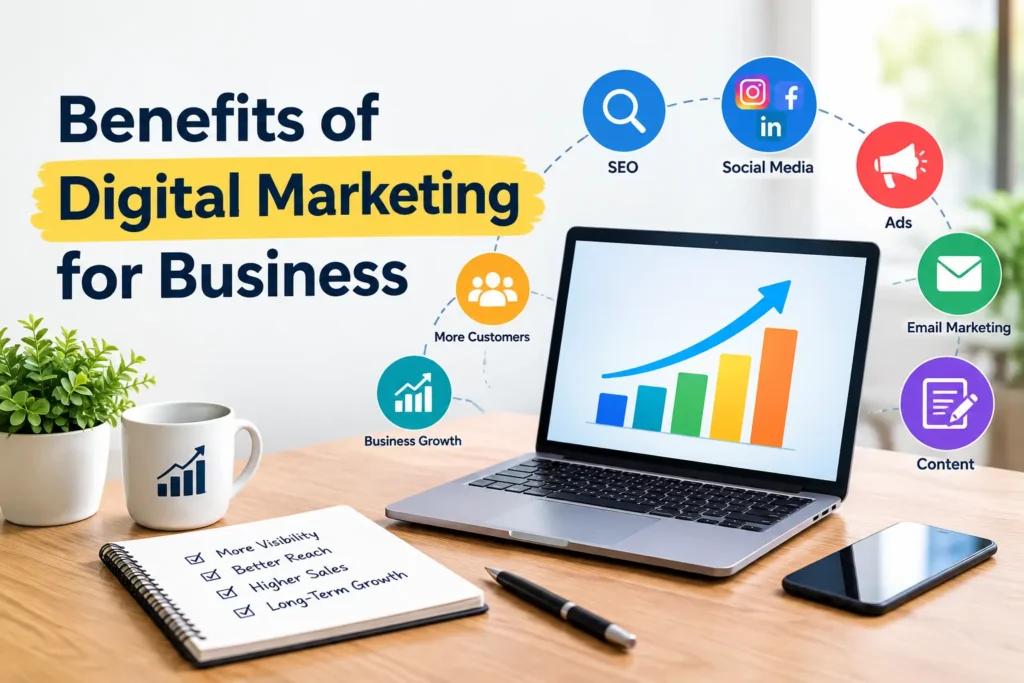
Benefits of digital marketing for business have become more important as customers increasingly use search engines, social media, websites, and online platforms to find products and services. Whether you run a small local shop, a service company, a startup, or an established organization, digital marketing can help you connect with the right audience and build a stronger online presence.
What Is Digital Marketing?
Digital marketing means promoting a business, product, or service through online channels. These channels can include search engines, social media platforms, websites, email, online advertising, and content.
Unlike traditional marketing, digital marketing gives businesses more opportunities to communicate directly with their target audience. It also allows businesses to track campaigns and understand how people interact with their content.
There are many benefits of digital marketing for business, especially for companies that want to increase their online visibility and reach potential customers.
1. Helps You Reach More Customers
One of the biggest advantages of digital marketing is the ability to reach people beyond your immediate location.
A local business can promote its services to people in a specific city, while an online business can reach customers across different regions or countries.
For example, a digital marketing company in Jalandhar can use SEO, social media, and paid advertising to reach businesses searching for marketing services in Jalandhar and nearby areas.
This wider reach can create more opportunities to attract potential customers.
2. Builds a Strong Online Presence
Today, many customers search online before making a decision. They may look for your website, Google Business Profile, social media pages, reviews, or other information about your company.
A strong digital presence helps customers understand who you are and what you offer.
Regularly publishing useful content, maintaining an updated website, and staying active on relevant social media platforms can make your business easier to find online.
Building this presence is one of the important benefits of digital marketing for business because customers can interact with your brand even outside normal business hours.
3. Cost-Effective Marketing
Traditional advertising methods such as television, newspapers, radio, and large outdoor advertisements can require significant budgets.
Digital marketing offers businesses different options based on their available resources.
For example, a business can start with organic social media content, SEO, blogs, and email marketing. It can then introduce paid advertising when it is ready.
This flexibility allows small businesses to start marketing online without necessarily requiring a huge advertising budget.
4. Helps You Target the Right Audience
Digital marketing allows businesses to focus their marketing efforts on specific audiences.
Depending on the platform and campaign, businesses may be able to target people based on factors such as location, interests, demographics, search behaviour, or previous interactions.
For example, a local restaurant may want to reach people within a particular area, while an online clothing store may want to reach customers interested in a particular type of clothing.
Reaching a more relevant audience can help businesses use their marketing resources more efficiently.
5. Improves Brand Awareness
People are more likely to remember a business when they see useful and consistent content from it over time.
Social media posts, videos, blogs, advertisements, email newsletters, and website content can all contribute to brand awareness.
You do not always need to make every post promotional. Educational and entertaining content can also help people become familiar with your brand.
Over time, consistent communication can help create recognition among your target audience.
6. Generates More Leads
A well-planned digital marketing strategy can help bring potential customers to your website, social media pages, landing pages, or contact forms.
For example, a person might find your blog through Google, visit your website, learn about your services, and then contact your business.
Similarly, someone might see your social media post and send you a message asking about your product.
These interactions can become potential leads for your business.
7. Helps Increase Sales
Digital marketing can support customers throughout their buying journey.
A customer may first discover your business through social media, visit your website, read your content, check reviews, and eventually contact you or make a purchase.
Businesses can use different digital channels to provide information at each stage.
Good website content, clear calls to action, useful product information, customer reviews, and targeted advertising can all help make the buying process easier.
8. Makes It Easier to Measure Results
Another important advantage of digital marketing is that many activities can be measured.
Businesses can track information such as:
- Website visitors
- Search traffic
- Social media engagement
- Advertisement clicks
- Leads
- Phone calls
- Form submissions
- Online purchases
- Conversion rates
This information can help you understand which activities are producing useful results.
Instead of simply spending money on advertising and hoping it works, businesses can review performance and make changes based on available data.
9. Helps You Understand Your Customers
Digital platforms can provide useful insights into how people interact with your business.
You can learn which pages people visit, which content receives attention, what questions customers ask, and which products or services generate interest.
These insights can help you improve your marketing strategy.
For example, if a particular blog topic receives significant traffic, you may decide to create more content around that subject.
10. Supports Local Businesses
Digital marketing is not only useful for large companies. It can be particularly valuable for local businesses.
A local business can optimize its website for location-based searches, maintain its Google Business Profile, collect genuine customer reviews, and publish location-relevant content.
When people search for businesses or services in their area, having accurate and useful online information can help them discover your company.
This is one of the practical benefits of digital marketing for business for companies that depend heavily on local customers.
11. Helps You Build Customer Relationships
Marketing should not stop after a customer makes a purchase.
Businesses can continue communicating with customers through email, social media, useful content, loyalty programs, and other online channels.
You can share product updates, helpful tips, announcements, offers, and information that your customers may find useful.
Maintaining communication can help businesses stay connected with their existing audience.
12. Gives Small Businesses More Opportunities
Large companies may have bigger marketing budgets, but digital platforms allow small businesses to compete for attention in online spaces.
A small business can create useful content, optimize its website, build a social media presence, collect reviews, and use targeted advertising.
The key is not simply spending more money. It is understanding the audience and creating a strategy that matches the business goals.
This is why the benefits of digital marketing for business can be valuable for businesses of different sizes.
13. Helps You Stay Competitive
Customers have many choices today. If competitors are visible online while your business is difficult to find, potential customers may never discover your products or services.
Having a website, active digital channels, useful content, and a strong online presence can help your business remain visible in a competitive market.
You can also monitor competitors’ content, offers, and online activities to identify areas where your own marketing can improve.
14. Allows Personalized Communication
Digital platforms make it easier to create content for different groups of customers.
For example, a business can create separate campaigns for new customers and existing customers.
An online store could show new products to one audience while sending special offers to previous customers.
More relevant communication can make marketing messages more useful and less generic.
15. Works Around the Clock
Your website and online content can be available 24 hours a day.
A potential customer can visit your website at night, read your services, check your FAQs, view your portfolio, or submit an enquiry even when your office is closed.
This gives businesses an opportunity to receive enquiries outside traditional working hours.
How to Get Started With Digital Marketing
You do not need to use every digital marketing channel immediately.
Start by understanding your target audience and defining your business goals.
Then focus on the basics:
- Create a professional and mobile-friendly website.
- Set up and optimize your Google Business Profile.
- Choose relevant social media platforms.
- Create useful and original content.
- Work on SEO to improve online visibility.
- Collect genuine customer reviews.
- Consider paid advertising when appropriate.
- Track your results regularly.
- Improve your strategy based on performance.
The most effective strategy will depend on your business type, audience, location, competition, and goals.
Final Thoughts
The benefits of digital marketing for business go beyond simply getting more followers or website visitors. Digital marketing can help businesses become easier to find, communicate with customers, generate leads, build brand awareness, and understand what their audience wants.
The important thing is to focus on the right channels instead of trying to do everything at once.
Start with a clear goal, understand your customers, create useful content, and measure your results. With consistent effort, digital marketing can become an important part of your overall business growth strategy.
If you want to improve your online presence, RK Info Tech can help with digital marketing services including SEO, social media marketing, website development, online advertising, and content marketing.
Frequently Asked Questions
1. What are the main benefits of digital marketing for business?
The main benefits of digital marketing for business include reaching a larger audience, improving online visibility, generating leads, increasing brand awareness, building customer relationships, and measuring marketing performance. It also gives businesses different options for reaching their target audience.
2. Why is digital marketing important for small businesses?
Digital marketing can help small businesses become more visible online and reach potential customers without relying only on traditional advertising. Businesses can use SEO, social media, content marketing, email marketing, and paid advertising according to their goals and budget.
3. Can digital marketing help increase sales?
Yes. Digital marketing can help businesses attract potential customers and guide them toward making an enquiry or purchase. A combination of a good website, useful content, SEO, social media, reviews, and advertising can support the customer journey.
4. Is digital marketing expensive?
The cost depends on the strategy. Some activities, such as creating organic social media content and basic website content, can be started with limited spending. Paid advertising requires a separate budget. Businesses can choose strategies according to their resources and objectives.
5. How does SEO benefit a business?
SEO helps improve a website’s visibility in search engine results for relevant searches. When potential customers search for products or services related to your business, SEO can help your website appear in front of them.
6. Can digital marketing help a local business?
Yes. Local businesses can use local SEO, Google Business Profile optimization, social media, customer reviews, and location-focused website content to improve their online presence and connect with people in their service area.
7. What digital marketing strategy should a business start with?
There is no single strategy that works for every business. Start by identifying your target audience and goals. A local service business may focus on local SEO and Google Business Profile, while an online store may focus on SEO, social media, content, email, and paid advertising.
8. How long does digital marketing take to show results?
The timeframe varies depending on the marketing channel and business. Paid advertising can produce traffic relatively quickly, while SEO and content marketing generally require consistent effort over a longer period. Competition and the quality of the strategy can also affect results.
9. Why is social media important for businesses?
Social media allows businesses to communicate with their audience, share content, showcase products or services, answer questions, and build brand awareness. The most suitable platform depends on where the target audience spends time.
10. How can a business measure digital marketing results?
Businesses can monitor metrics such as website traffic, leads, enquiries, conversions, social media engagement, advertising clicks, and sales. Tracking relevant metrics helps businesses understand which marketing activities are contributing to their goals.
11. Can digital marketing improve brand awareness?
Yes. Consistent content across websites, search engines, social media, email, and advertising can help more people become familiar with a business. Useful and consistent communication can help build recognition over time.
12. What are the long-term benefits of digital marketing for business?
Long-term benefits of digital marketing for business can include stronger online visibility, a growing audience, better customer relationships, improved brand recognition, more website traffic, and a consistent source of potential leads. The results depend on the strategy, industry, competition, and consistency.