
Meta Ads vs Google Ads is a common question for businesses that want to promote their products or services online. Both advertising platforms can help businesses reach potential customers, generate leads, increase website traffic, and support sales. However, they work differently and are designed around different types of user behaviour. Understanding these differences can help you choose an advertising approach that matches your business goals.
What Are Meta Ads?
Meta Ads are paid advertisements that run across platforms owned by Meta, including Facebook and Instagram. Businesses can use these ads to promote products, services, websites, videos, offers, events, and more.
Meta advertising is particularly focused on reaching audiences based on factors such as interests, demographics, location, online activity, and interactions with content.
For example, a clothing brand can show attractive product images or videos to people who may be interested in fashion. A local service business can promote its services to people in a particular city or area.
Meta Ads can be useful when your goal is to introduce your brand to potential customers and create interest.
What Are Google Ads?
Google Ads is Google’s online advertising platform. Businesses can use it to display advertisements across Google’s search results and other Google advertising channels.
One major feature of Google Search Ads is that they can reach people when they are actively searching for a product, service, or solution.
For example, someone searching for “digital marketing company in Jalandhar” may already be looking for a digital marketing service. A business offering that service can use Google Ads to appear for relevant searches.
This makes search advertising particularly useful for businesses that want to reach people with existing search intent.
Meta Ads vs Google Ads: How Do They Work?
The main difference between Meta Ads vs Google Ads is often the way businesses reach potential customers.
Meta Ads generally introduce products or services to people while they are browsing social media. The user may not have been actively looking for the product when they see the advertisement.
Google Search Ads, on the other hand, can reach people when they are actively searching for something.
Think of it this way:
Meta Ads: “Here is something you may be interested in.”
Google Ads: “You are searching for something, and here is a business that offers it.”
Both approaches can be useful, depending on the business and campaign objective.
Audience Targeting
Audience targeting is an important part of online advertising.
Meta Ads provide different targeting options that can help businesses reach people based on characteristics, interests, behaviours, location, and interactions.
Google Ads can use search keywords and other audience signals to connect advertisements with people searching for relevant products and services.
For example, a local gym could use Meta Ads to introduce its membership plans to people in a specific area who may be interested in fitness.
The same gym could use Google Ads to reach people searching for terms such as “gym near me” or “fitness centre in Jalandhar.”
The best approach depends on how your potential customers discover businesses like yours.
Search Intent vs Social Discovery
This is one of the most important differences when comparing Meta Ads vs Google Ads.
Google Search Ads are often connected with active search intent. A person types a query into Google because they are looking for information, a product, or a service.
Meta Ads work differently. People usually visit Facebook or Instagram to browse content, communicate with others, watch videos, or explore topics. An advertisement can appear as part of that experience.
This means Google can be useful when customers already know what they need, while Meta can be useful for introducing products, services, brands, and offers to relevant audiences.
Which Platform Is Better for Brand Awareness?
Both platforms can support brand awareness, but they do it in different ways.
Meta Ads can use visual formats such as images, videos, carousels, stories, and reels. This gives businesses opportunities to show their brand personality and products visually.
Google Ads can also support brand visibility, especially when businesses appear for relevant searches. However, search ads are often more focused on the user’s immediate query.
If your product needs visual presentation or storytelling, Meta may provide useful creative opportunities.
Which Platform Is Better for Lead Generation?
Both Meta Ads and Google Ads can be used to generate leads.
A business can use Meta lead campaigns to collect information from interested users through forms or direct enquiries.
Google Ads can direct users to a website or landing page where they can fill out a form, call the business, or complete another desired action.
For example, a real estate company could use Meta Ads to generate enquiries from people interested in property.
The same company could use Google Ads to target people searching for specific property-related services.
The results can vary depending on the industry, audience, advertisement, landing page, budget, and campaign setup.
Meta Ads vs Google Ads for E-Commerce
For online stores, both platforms can be useful.
Meta Ads can showcase products using attractive images, videos, carousels, and other visual formats. This can help introduce products to potential buyers and bring them back to the website.
Google Ads can reach people searching for specific products or product categories. Shopping-focused campaigns can also display product information to users in relevant contexts.
An e-commerce business may use both platforms as part of a broader customer journey.
For example, a person may first discover a product on Instagram and later search for the product or brand on Google.
Meta Ads vs Google Ads for Local Businesses
Local businesses can also use both platforms.
A restaurant could use Meta Ads to promote a special offer to people in nearby areas.
The same restaurant could use Google Ads to reach people searching for phrases such as “restaurant near me” or “best restaurant in Jalandhar.”
A service business can similarly use Google Search Ads to reach people actively looking for its services while using Meta Ads to create awareness among local audiences.
Location targeting can therefore play an important role on both platforms.
Cost of Meta Ads vs Google Ads
There is no fixed price for advertising on either platform.
The cost can vary based on factors such as:
- Industry
- Competition
- Audience
- Location
- Campaign objective
- Ad quality
- Keywords
- Budget
- Time of year
- Landing page experience
Google Search Ads often involve competition around keywords, while Meta Ads involve competition for advertising placements and audiences.
Instead of asking which platform is always cheaper, businesses should look at the cost of achieving their specific goal.
For example, one business may receive affordable leads from Meta while another may find Google Search more suitable for its target customers.
Ad Formats
Another major difference in Meta Ads vs Google Ads is the variety of creative formats.
Meta supports formats such as:
- Image ads
- Video ads
- Carousel ads
- Stories
- Reels
- Collection-style experiences
- Lead forms
Google offers different advertising formats across its ecosystem, including search ads, shopping-related formats, display advertising, video advertising, and other campaign types.
The appropriate format depends on your campaign objective and where your audience spends time.
What Should You Choose?
There is no universal answer to the Meta Ads vs Google Ads question.
Your decision should depend on your business, audience, product, customer journey, budget, and marketing objective.
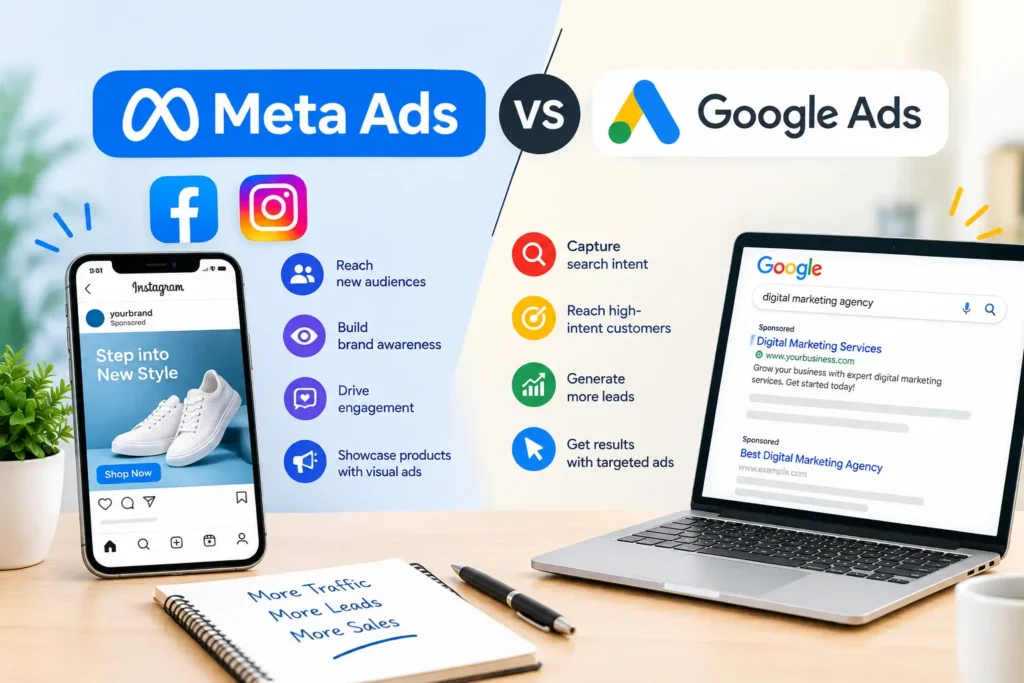
Consider Meta Ads if you want to:
- Build brand awareness
- Promote visual products
- Reach interest-based audiences
- Promote offers
- Generate social engagement
- Introduce your business to new audiences
Consider Google Ads if you want to:
- Reach people actively searching
- Promote specific services
- Capture search demand
- Generate website enquiries
- Promote products through relevant searches
- Reach customers with a clear need
These are general considerations rather than rules. The performance of either platform depends heavily on campaign setup and execution.
Can You Use Meta Ads and Google Ads Together?
Yes. Businesses do not necessarily have to choose only one platform.
Using both can allow businesses to reach customers at different stages of the buying journey.
For example, a customer might see a business on Instagram, visit its website, and later search for the business or service on Google.
A combined strategy can also allow businesses to test different audiences, messages, and advertising channels.
The important thing is to track results separately so you understand which campaigns are contributing to your business objectives.
How to Choose the Right Advertising Platform
Before starting a campaign, ask yourself a few simple questions:
Who is my target customer?
Understand their age, location, interests, needs, and online behaviour.
What am I selling?
A visually appealing product may work well with image or video advertising, while a service with strong search demand may benefit from search advertising.
What is my goal?
Your goal could be brand awareness, website traffic, leads, enquiries, app installs, or sales.
How do customers find businesses like mine?
If customers usually search for your service when they need it, Google may be relevant. If they discover products through social content, Meta may be useful.
What does my data show?
Test your campaigns, track the results, and make decisions based on your own business data.
Final Thoughts
The Meta Ads vs Google Ads comparison is not really about finding one platform that works for every business. Both platforms offer different ways to reach potential customers.
Meta Ads can help businesses create awareness and reach audiences through engaging social content. Google Ads can help businesses connect with people who are actively searching for products and services.
For some businesses, one platform may be the primary advertising channel. For others, using both may make sense.
The best starting point is to understand your customers, define your marketing objective, set a realistic budget, and test your campaigns carefully.
At RK Info Tech, we help businesses understand digital advertising, create online campaigns, and build strategies designed around their business goals. A well-planned advertising strategy can help you reach the right audience and make better use of your marketing budget.
Frequently Asked Questions
1. What is the difference between Meta Ads and Google Ads?
The main difference in Meta Ads vs Google Ads is how they reach users. Meta Ads generally reach people while they are browsing platforms such as Facebook and Instagram, while Google Search Ads can reach people when they actively search for specific products, services, or information.
2. Are Meta Ads better than Google Ads?
There is no single platform that is better for every business. Meta Ads and Google Ads have different strengths. Your choice should depend on your target audience, product or service, marketing objective, budget, and customer journey.
3. Are Google Ads expensive?
Google Ads costs vary depending on factors such as keywords, competition, location, industry, and campaign settings. Businesses can set budgets and monitor campaign performance to manage their advertising spend.
4. Are Meta Ads expensive?
Meta Ads costs can vary depending on the audience, competition, campaign objective, advertisement, location, and other factors. Businesses can control their budget and test different campaigns to understand their costs and results.
5. Which is better for lead generation?
Both Meta Ads and Google Ads can generate leads. Google can be useful for reaching people who are actively searching for a service, while Meta can help businesses reach selected audiences and encourage them to submit an enquiry or contact the business.
6. Which is better for brand awareness?
Meta Ads can be useful for visual brand awareness because Facebook and Instagram support image, video, Stories, Reels, and carousel formats. Google advertising can also increase visibility, particularly when a business appears for relevant searches.
7. Can a small business use Meta Ads and Google Ads?
Yes. Small businesses can use either platform or both, depending on their goals and available budget. Starting with a clearly defined audience and a specific campaign objective can make it easier to measure results.
8. Which platform is better for local businesses?
Both platforms can support local businesses. Google Ads can help reach people searching for local services, while Meta Ads can target audiences based on location and other characteristics. The right option depends on how customers discover your business.
9. Can I run Meta Ads and Google Ads at the same time?
Yes. Businesses can run campaigns on both platforms simultaneously. This can help them reach audiences through different channels. However, each campaign should have clear objectives and should be measured separately.
10. How do I decide between Meta Ads vs Google Ads?
Start by understanding your customer and how they search for or discover your product or service. Consider whether you need to capture existing search demand or create awareness among potential customers. Then test the platform that best matches your objective and evaluate the results.
11. Do I need a website to run Google Ads?
Not every Google advertising campaign requires the same setup, but for many search campaigns, a dedicated and relevant landing page or website page is important. The page should clearly explain the offer and make it easy for visitors to take the desired action.
12. What should I track in advertising campaigns?
Important metrics can include impressions, clicks, click-through rate, cost per click, leads, conversions, cost per lead, sales, and return on advertising spend where applicable. The most useful metrics depend on your campaign objective.
13. Can RK Info Tech manage Meta Ads and Google Ads?
Yes. RK Info Tech can help businesses with digital advertising strategy and campaign-related services. The approach can be planned around your target audience, location, business goals, and available advertising budget.